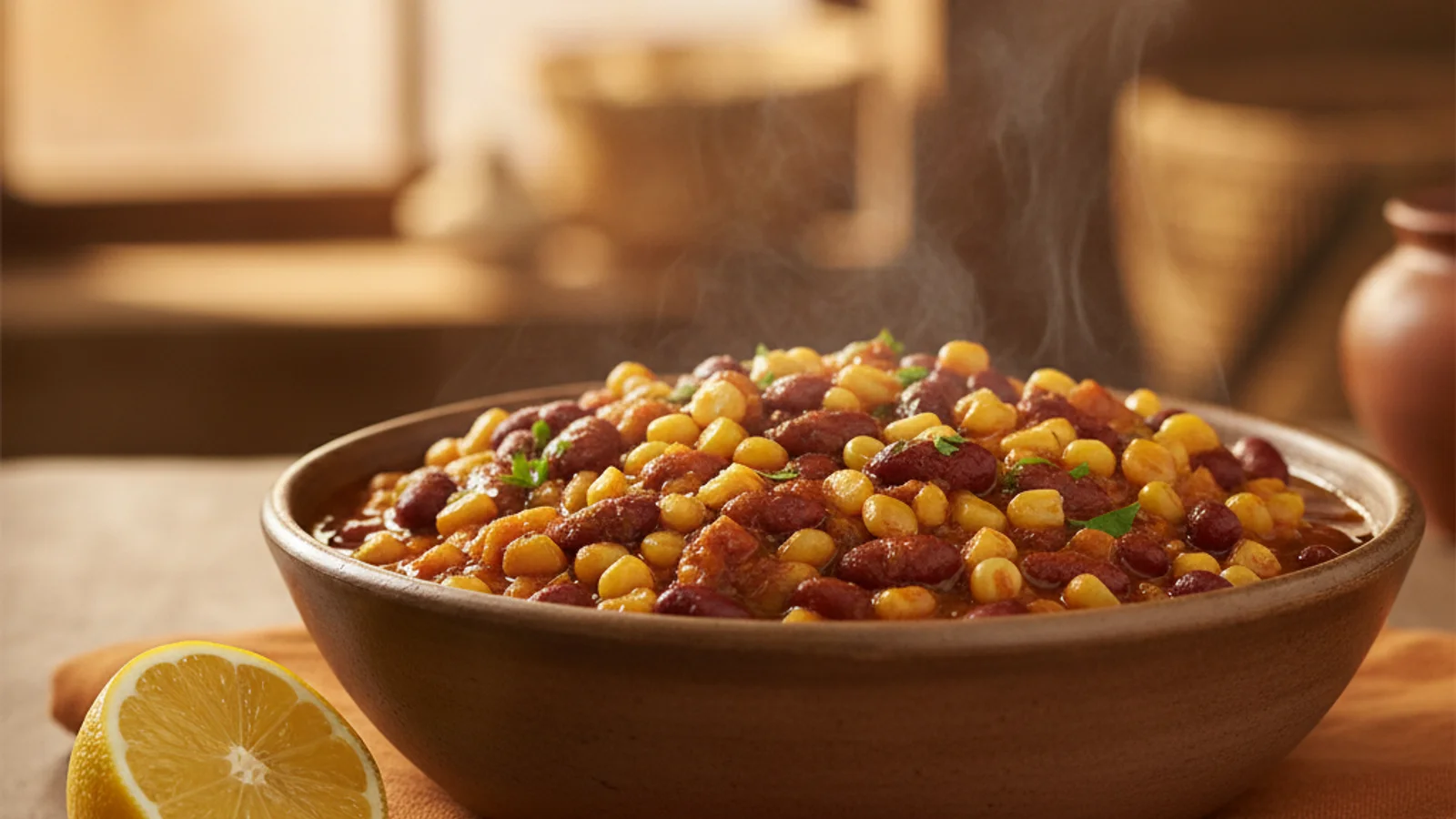
What your body actually absorbs from a plate of githeri
Githeri — maize and beans boiled together, sometimes with a bit of onion, tomato, or greens folded in — is one of the most nutritionally dense everyday meals in Kenya. On paper, it looks close to complete: iron, zinc, calcium, and a bit of vitamin A if vegetables are added. The gap between that paper and your actual blood chemistry is the whole point of this article.
What's on the plate
Take a standard bowl of githeri — roughly 1 cup maize, 1 cup beans, cooked plain. The food composition data looks like this:
- Iron: ~5.2mg — mostly non-heme iron from the beans.
- Zinc: ~2.1mg — from both maize and beans.
- Calcium: ~60mg — modest, mostly from the beans.
- Vitamin A: ~0mcg unless vegetables are added — maize and beans alone carry essentially none.
What actually reaches your blood — the unenhanced plate
Beans and maize are both high in phytates, and beans additionally carry tannins and other polyphenols that further bind minerals. Eaten plain, with chai alongside as many households do, this plate performs poorly against its paper values:
Non-heme iron absorption in a phytate-heavy, tannin-present meal like this commonly falls to 10-20% of what's present — so roughly 1mg out of 5.2mg. Zinc follows a similar pattern, dragged down by the same phytates. Calcium absorption from beans without an enhancer sits low too. And without any vegetable added, there's no vitamin A on the plate to begin with, so there's nothing to absorb.
The same meal, enhanced
Now make four changes that cost nothing extra and take minutes: soak the beans overnight before cooking (reduces phytate), squeeze half a lemon over the finished plate (adds vitamin C), stir in sukuma wiki cooked with a spoon of oil (adds vitamin A precursors and fat for absorption), and push your chai to two hours after eating instead of drinking it with the meal.
Soaking beans overnight breaks down a meaningful share of their phytate before cooking even starts. Lemon's vitamin C then does the heavy lifting on iron — vitamin C can increase non-heme iron absorption 2 to 6 times in a single meal, which is most of the jump you see between 1mg and 3.5mg above. Zinc improves for the same phytate-reduction reason, though less dramatically since fewer strong zinc enhancers exist. Calcium more than doubles, still limited by the oxalates and phytates beans carry even after soaking. And vitamin A goes from zero to a meaningful contribution the moment you add a dark green — carotenoids from sukuma wiki need dietary fat to be absorbed at all, which is exactly what the spoon of cooking oil provides.
Why this matters more than swapping foods
None of these four changes require different food, more money, or more time than most households already spend cooking githeri. Soaking beans is passive — you do it before bed. Lemon costs a few shillings. Sukuma wiki is likely already in the kitchen. Chai timing costs nothing at all. Yet stacked together, they roughly triple the iron your body keeps from the same bowl, more than double the zinc and calcium, and turn a vitamin-A-free plate into one that contributes meaningfully toward your daily need.
The takeaway: the githeri you're already cooking is not the problem — the preparation around it is. Soak your beans, add lemon, cook your greens with a bit of oil, and hold your chai for two hours. Same plate, same cost, a meal that finally delivers close to what its ingredients promise.
Sources
- FAO/INFOODS Food Composition Table for Kenya. FAO (2018)
- Phytic acid and iron absorption. International Journal of Food Sciences and Nutrition (2002). DOI
- Inhibition of iron absorption by polyphenolic-containing beverages. British Journal of Nutrition (1999). DOI
- Guidelines on food fortification with micronutrients. WHO/FAO (2006)
Get nutrition insights like this in your inbox